Webbing Screen Room Dividers: A Complete Guide to Waterproof Woven Partition Panels for Indoor and Outdoor Spaces
- Share
- publisher
- QUANSHUN WEBBING
- Issue Time
- Jul 31,2026
Summary
Discover how webbing screen room dividers combine waterproof woven materials, UV resistance, and modern design for patio, balcony, and indoor partition solutions.
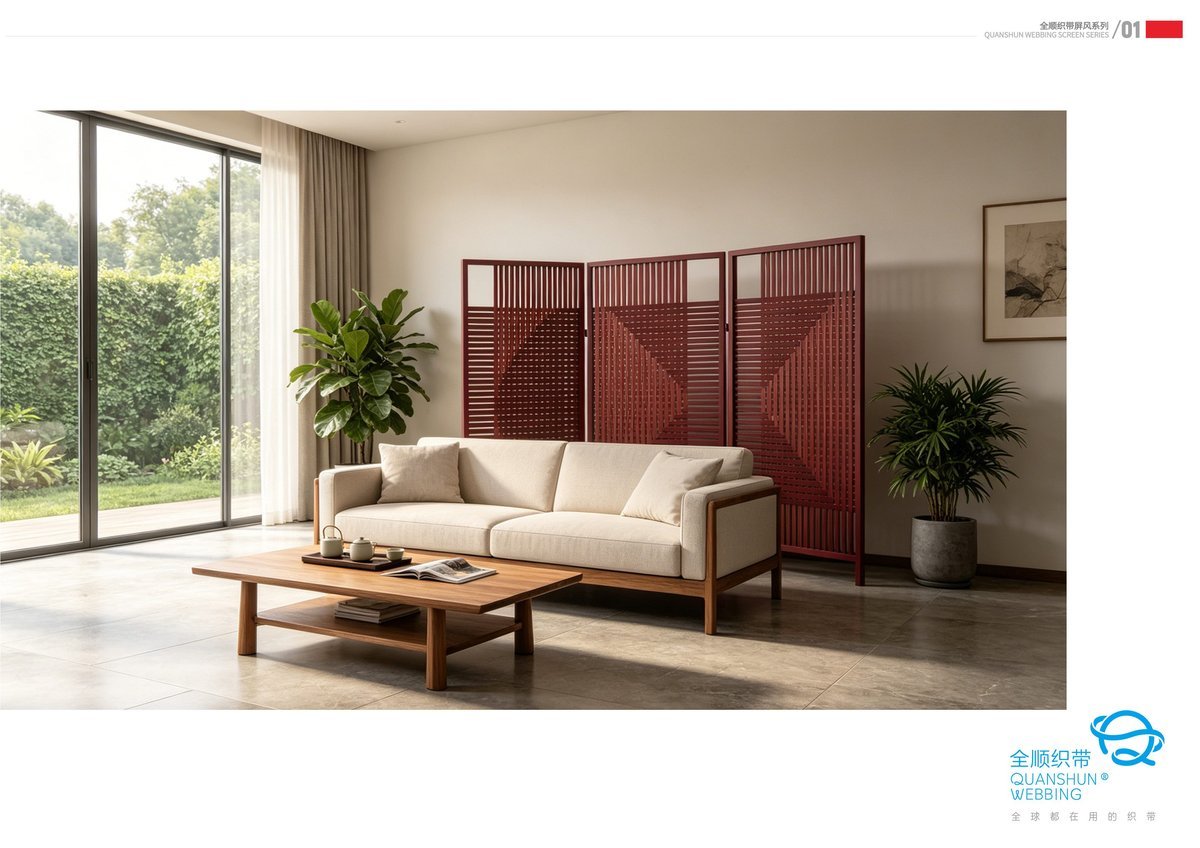
Open-plan living, rooftop entertaining, and balcony dining have pushed the demand for flexible space division to an all-time high. Among the many partition solutions available today, the webbing screen stands out for one simple reason: it combines the handcrafted texture of woven textile panels with the engineered durability of outdoor-grade braided rope. Whether used as a freestanding room divider in a living room, a privacy screen on a patio, or a decorative partition in a commercial lounge, a webbing screen delivers both visual warmth and structural resilience that fabric-only or rigid metal screens cannot match.
What Is a Webbing Screen?
A webbing screen is a partition panel built from tightly woven webbing material stretched across a rigid frame. Unlike flat fabric screens that sag or tear under tension, webbing is engineered as a high-strength woven strip that distributes load evenly across the panel surface. The result is a screen that holds its shape, resists tearing, and maintains a consistent weave pattern even after years of indoor or outdoor exposure.
QUANSHUN WEBBING's screen series takes this concept further with polyester outdoor braided rope and a distinctive square straight dual-colour splicing texture. The collection includes folding three-panel designs, freestanding curved-frame units, and modular multi-panel systems — each scalable to custom dimensions and colourways for residential, hospitality, and contract projects.
Why Webbing Screen Dividers Outperform Traditional Partitions
Traditional room dividers fall into a few familiar categories, each with inherent limitations. Solid wood panels are heavy and block light entirely. Fabric curtains collect dust and sag over time. Metal grilles look industrial and conduct heat in direct sun. Glass partitions are fragile and show every fingerprint. The webbing screen solves these problems simultaneously:
- Breathability: The woven structure allows air to flow through the panel, preventing the stuffy, closed-in feeling that solid partitions create. This matters especially in small apartments, covered patios, and semi-enclosed commercial spaces where airflow is essential for comfort.
- Light filtration: Webbing screens filter rather than block natural light, casting soft patterns and maintaining visual connection between divided zones. This is why interior designers increasingly specify woven webbing panels for open-plan lofts and studio apartments.
- Weight-to-strength ratio: A typical webbing screen panel weighs a fraction of a comparable solid wood panel, yet the woven webbing can support significant lateral load without deformation. This makes the screen easy to reposition, fold, and store seasonally.
- Texture and visual depth: The woven surface introduces a tactile, handcrafted quality that flat materials lack. From a distance, a webbing screen reads as a textured wall feature; up close, the dual-colour weave becomes a point of visual interest in itself.
Waterproof Properties of Webbing Screen Materials
The single most important technical advantage of a webbing screen over fabric or natural-fibre alternatives is its waterproof performance. Polyester outdoor braided rope used in QUANSHUN WEBBING screen panels is engineered to resist moisture absorption. Water beads on the surface and evaporates or runs off, rather than soaking into the fibres. This is fundamentally different from cotton, linen, or paper-based screens that wick moisture, develop water stains, and eventually rot.
In practice, this means a webbing screen left on a patio during a summer rainstorm will dry within minutes once the rain stops, with no lasting damage, no mildew growth, and no loss of structural integrity. The same screen used indoors in a humid bathroom or kitchen environment will not absorb cooking steam or shower condensation — a critical advantage over rattan or cane webbing, which can warp and buckle in consistently humid rooms.
Waterproof webbing also simplifies cleaning. Spills, food stains, and dust accumulation can be wiped away with a damp cloth and mild detergent. There is no need to disassemble the screen, remove a fabric cover, or use specialised cleaning equipment. For commercial applications — restaurant terraces, hotel pool decks, event venues — this low-maintenance characteristic translates directly into reduced housekeeping costs.
UV Resistance and Color Fastness in Webbing Screens
Outdoor partition screens face a relentless adversary: ultraviolet radiation. Prolonged sun exposure breaks down the chemical bonds in ordinary fabrics, causing fading, embrittlement, and eventual disintegration. A webbing screen designed for outdoor use addresses this at the material level through UV-stabilised polyester construction and solution-dyed colour integration.
Solution dyeing — the process of adding colour pigment to the polymer before the yarn is extruded — ensures that colour penetrates the entire fibre cross-section rather than sitting on the surface. The practical consequence is dramatic: a solution-dyed polyester webbing screen can withstand hundreds of hours of direct UV exposure with minimal colour shift, compared to surface-dyed fabrics that may show visible fading within a single season.
For specifiers selecting a webbing screen for a sunny balcony, south-facing patio, or rooftop terrace, UV resistance is a baseline requirement. Screens manufactured without UV stabilisation will fade unevenly, with the sun-facing side becoming noticeably lighter than the shaded side, creating an unprofessional and worn appearance within months. Always verify that the webbing material carries a documented UV resistance rating for outdoor installations.
Outdoor Applications: Patio, Balcony, and Garden Webbing Screens
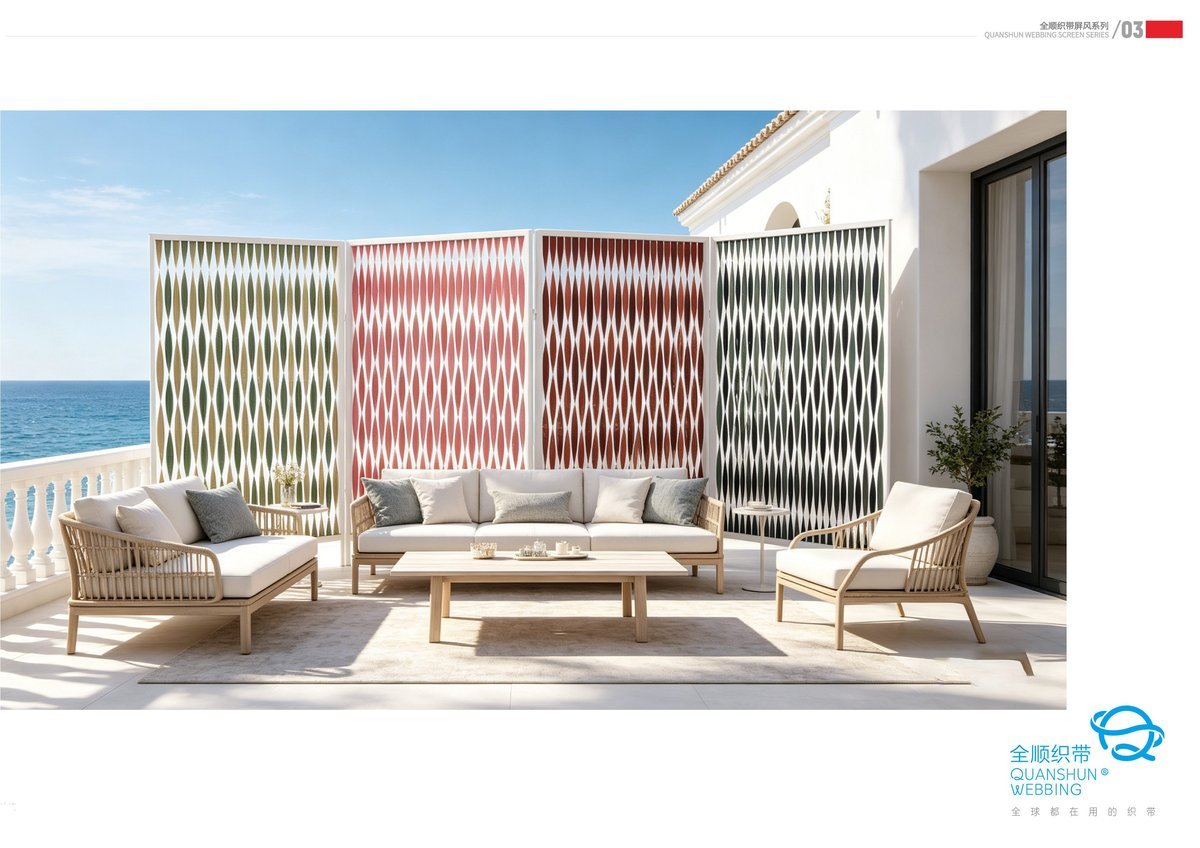
The outdoor webbing screen has become a staple in residential and hospitality landscape design because it solves the privacy problem without building permanent walls. The PF-003 series shown above demonstrates how multi-panel webbing partitions can transform a terrace into a series of intimate outdoor rooms while preserving the open-air atmosphere.
On a balcony, a freestanding webbing screen creates an instant visual barrier between neighbouring units, turning an exposed railing into a private outdoor room. On a patio, a folding webbing partition separates the dining zone from the grill or lounge area, giving each function its own sense of place. In garden settings, webbing screens define outdoor rooms while simultaneously acting as a windbreak. The woven structure diffuses strong gusts rather than blocking airflow entirely, which is more comfortable than a solid wall and less likely to be blown over.
Commercial applications extend the concept further. Hotels use weather-resistant webbing screens to create semi-private cabana zones around pools. Restaurants deploy folding webbing partitions to flexibly define outdoor seating areas. Event venues use them as backdrops for outdoor weddings and corporate gatherings, where the woven texture adds visual warmth that a plain metal frame cannot provide.
Indoor Webbing Screen Dividers for Open-Plan Living
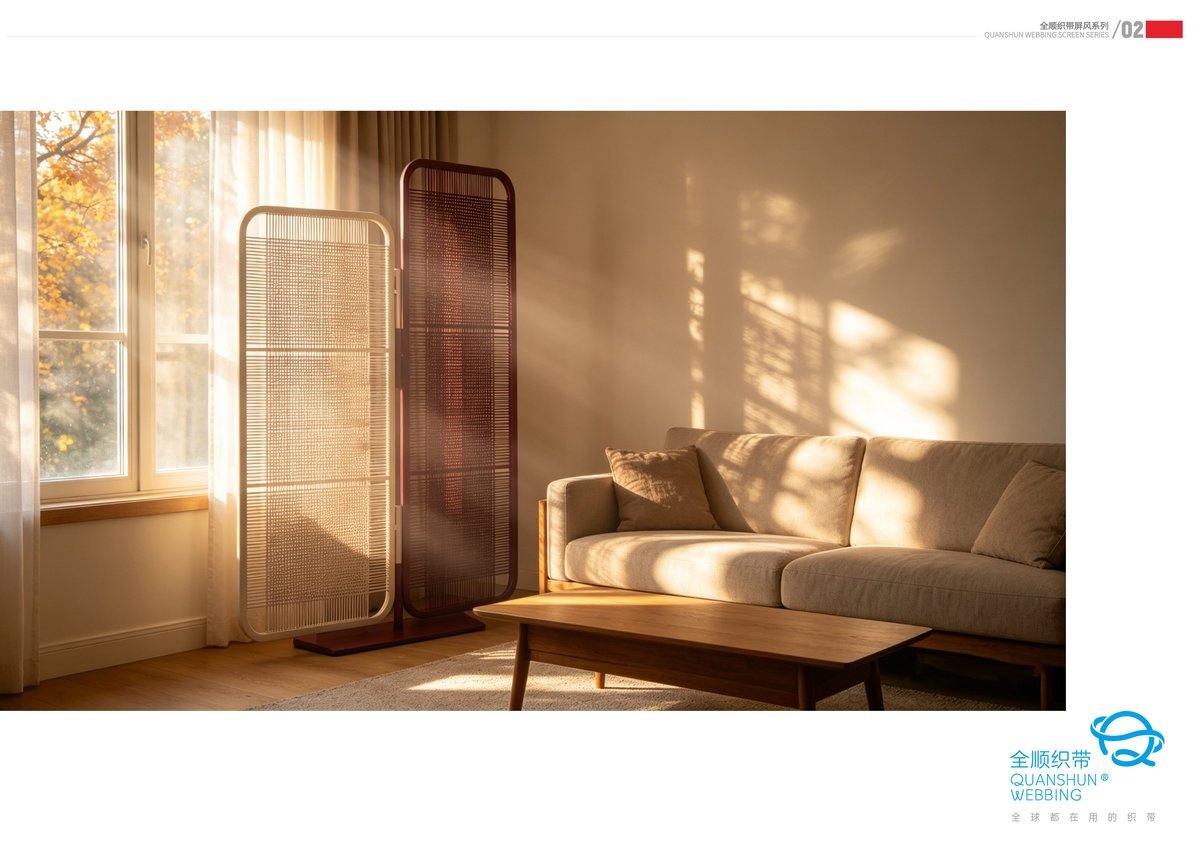
The rise of open-plan living has created a paradox: people want the spaciousness of an unpartitioned layout, but they also need defined zones for working, sleeping, dressing, and relaxing. The indoor webbing screen divider bridges this tension elegantly. The PF-002 curved-frame design shown here demonstrates how a freestanding woven panel can create a psychological boundary that supports focus, yet can be repositioned when the space returns to social use.
Interior designers favour webbing screens for several specific indoor scenarios. In studio apartments, a three-panel folding webbing screen like the PF-001 can separate the sleeping area from the living area without requiring permanent construction — an essential consideration for renters. In home offices carved from living-room corners, a webbing partition provides a visual cue that signals transition from domestic to professional mode, improving productivity without the claustrophobia of a full wall.
The aesthetic versatility of woven webbing also contributes to its indoor popularity. The dual-colour splicing in the QUANSHUN WEBBING collection — combining rich reds, warm neutrals, and subtle greens — complements Scandinavian, Japandi, bohemian, and modern interiors alike. The woven texture itself adds depth and interest to minimalist spaces that might otherwise feel sterile. Unlike flat fabric screens, the dimensional weave catches light differently throughout the day, creating subtle visual variation that enlivens a static room.
Material Options: Polyester, Polypropylene, and Acrylic Webbing
The performance of a webbing screen is determined almost entirely by the fibre from which the webbing is woven. Three materials dominate the market, each with distinct strengths:
| Material | Water Resistance | UV Resistance | Strength | Best For |
|---|---|---|---|---|
| Polypropylene | Excellent — does not absorb water | Good with UV stabilisers | High tensile strength | Budget outdoor screens, marine environments |
| Polyester (solution-dyed) | Very good — quick-drying | Very good — 1,000+ light hours | Excellent — resists stretching | Premium outdoor partitions, high-traffic commercial use |
| Acrylic (solution-dyed) | Good — treated for water repellency | Outstanding — best in class | Good — softer hand feel | High-end designer screens where colour longevity is critical |
Polypropylene remains the most widely used material for webbing screens because it offers the best balance of cost, durability, and weather resistance. It resists mould and mildew inherently and does not degrade when exposed to common solvents, oils, or acids — making it ideal for screens used near pools, in kitchens, or in industrial settings.
Solution-dyed polyester is the upgrade path when colour fastness and dimensional stability are paramount. Polyester webbing will not stretch under load the way polypropylene can, which means the weave pattern stays tight and uniform over a longer service life. For premium partitions that will be photographed, featured in design publications, or installed in high-visibility commercial spaces, polyester is often the specified material. The QUANSHUN WEBBING screen series currently uses polyester outdoor braided rope for its optimal balance of performance and visual refinement.
Solution-dyed acrylic occupies the top tier for UV performance. Acrylic fibres retain colour vibrancy longer than any other webbing material. The trade-off is a softer, less rigid hand feel, which can be an advantage for indoor decorative screens but may require additional frame support for large outdoor panels.
How to Choose the Right Webbing Screen for Your Space
Selecting a webbing screen involves matching material properties, dimensions, and design to the specific demands of the installation environment. The following criteria should guide every specification decision:
- Indoor or outdoor? Indoor screens can use lighter-weight webbing and wood frames. Outdoor screens require UV-stabilised, waterproof webbing on corrosion-resistant frames (aluminium, powder-coated steel, or treated hardwood).
- Privacy level needed. Tight-weave webbing provides near-total visual screening. Open-weave patterns allow partial sightlines and more light transmission — better for spaces where visual connection matters more than complete privacy.
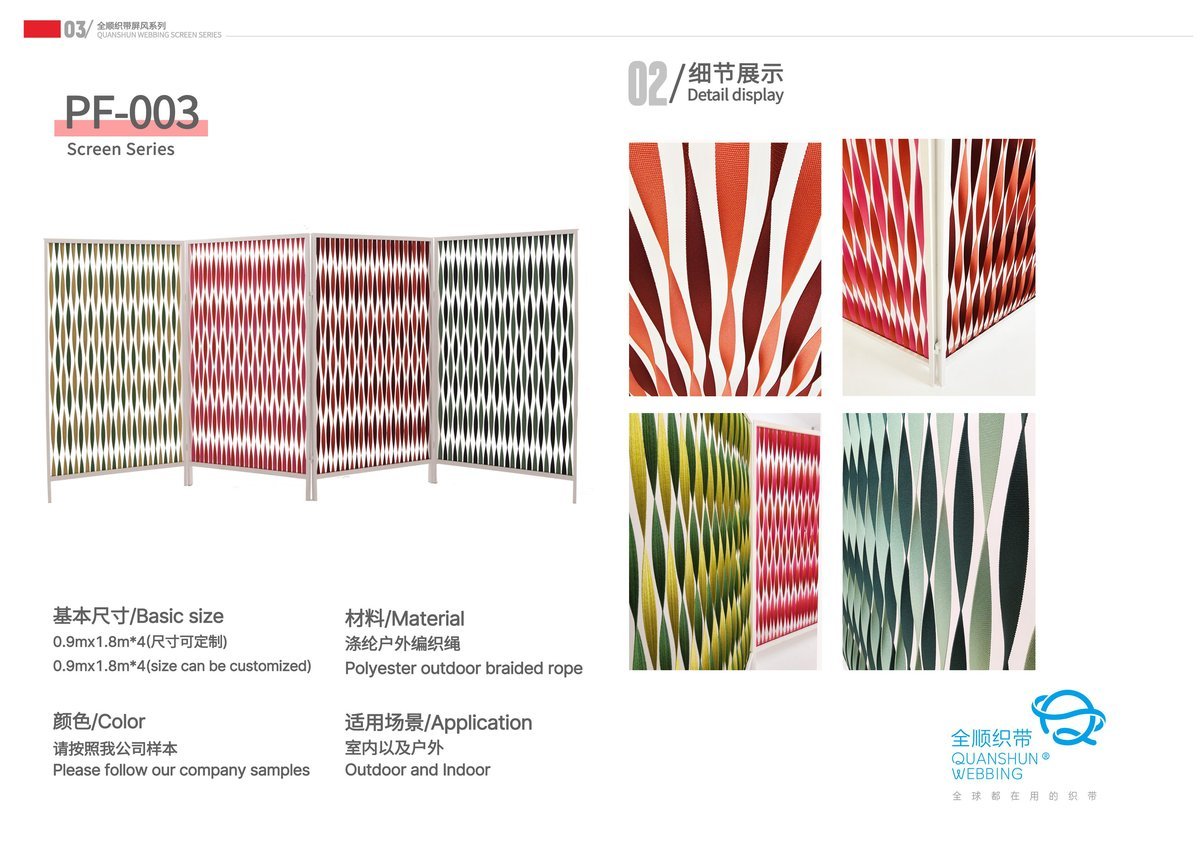
- Panel configuration. Three-panel folding screens like the PF-001 suit corners and small openings. Multi-panel configurations like the PF-003 provide broader coverage for patios and open-plan interiors. Single or double freestanding panels like the PF-002 work as accent pieces behind furniture.
- Frame material. Wood frames keep weight low and suit indoor use. Aluminium frames offer the best strength-to-weight ratio for outdoor screens. Powder-coated steel provides maximum stability in windy locations.
- Colour and weave pattern. Dark webbing reads as a graphic statement and hides dirt well. Neutral tones blend into most decors. Coloured webbing should always be solution-dyed for outdoor applications to ensure colour fastness.
- Custom sizing. QUANSHUN WEBBING screen series supports customised dimensions. For example, PF-001 can be produced at 0.9 m × 1.8 m per panel, with overall sizes scaled to project requirements.
Webbing Screen Maintenance and Care Tips
One of the most compelling arguments for choosing a webbing screen over alternatives is its minimal maintenance requirement. Unlike fabric screens that need removal and machine washing, or wood panels that require periodic refinishing, a well-made webbing screen needs only routine surface care to maintain its appearance and structural integrity.
For routine cleaning, wipe the webbing surface with a soft cloth dampened in a mild soap solution. Avoid abrasive sponges, bleach-based cleaners, or high-pressure washers, as these can damage the fibre surface and compromise UV inhibitors. Rinse with clean water and allow the screen to air-dry — polyester and polypropylene webbing will dry completely within 15 to 30 minutes in normal conditions.
Seasonal care for outdoor screens is equally straightforward. Before winter storage, clean the screen thoroughly, allow it to dry completely, and fold it flat in a dry storage area. Inspect hinges and frame connections for loose screws or corrosion, and tighten or replace hardware as needed. For screens that remain outdoors year-round in mild climates, periodic inspection of the webbing tension is advisable — if the weave begins to sag, the frame may need tightening or the webbing may need replacement.
With proper care, a quality polyester webbing screen will deliver five to eight years of service in outdoor conditions and considerably longer indoors. This longevity — combined with the low purchase price relative to built-in partitions — makes the webbing screen one of the most cost-effective space-division solutions on the market.
Custom Webbing Screen Solutions for Commercial Projects
For hospitality, retail, and contract furniture projects, standard off-the-shelf webbing screens rarely meet every specification requirement. Custom manufacturing opens possibilities for tailored panel dimensions, bespoke weave patterns, brand-specific colour matching, and frame materials engineered to project loads and wind conditions.
A specialised webbing manufacturer like QUANSHUN WEBBING can produce custom webbing screen panels in polyester outdoor braided rope and other webbing materials — with widths, thicknesses, and colours developed from reference swatches or Pantone references. OEKO-TEX Standard 100 certification ensures that all materials meet internationally recognised environmental and human-ecology safety standards, a prerequisite for many hospitality and healthcare projects.
For architects and designers specifying webbing screens for commercial installations, the key technical considerations extend beyond the webbing itself. Frame engineering must account for wind load at the installation site, particularly for rooftop and waterfront applications. Hinge hardware should be specified in stainless steel for corrosion resistance. Panel dimensions should be calculated to optimise material yield and minimise waste. Working directly with a manufacturer who controls both the webbing production and the frame fabrication streamlines quality control and ensures accountability for the finished product.
Beyond standard folding screens, custom webbing screen applications include fixed-frame architectural partitions, modular webbing wall systems for trade-show booths, and integrated webbing panels built into outdoor furniture suites. As open-air hospitality design and flexible workspace planning continue to evolve, the webbing screen is positioned to become an increasingly important element in the commercial designer's toolkit — a rare material that performs technically while contributing genuine warmth and texture to the built environment.
For more information on webbing materials, custom manufacturing capabilities, and partition screen specifications, explore our product catalogue or contact our team directly with your project requirements.